Ancient Origins

Aztec traditions
Aztec Traditions and the Origins of Día de los Muertos
Día de los Muertos has deep roots in the beliefs and traditions of the ancient Aztec civilization. Long before the arrival of the Spanish, the Aztecs honored their ancestors through ceremonies that celebrated the continuous cycle of life, death, and rebirth. Rather than viewing death as an end, they believed it was the beginning of another journey.
The Aztecs held festivals dedicated to the dead, offering food, flowers, incense, and personal belongings to help guide the spirits of loved ones. These ceremonies often took place during the summer months and were later combined with the Catholic observances of All Saints' Day and All Souls' Day after the Spanish conquest. Over time, these traditions evolved into the modern celebration of Día de los Muertos, observed on November 1 and 2.
Central to Aztec beliefs was the idea that the souls of the deceased could return to visit their families. Families welcomed them with offerings placed on altars, known today as ofrendas, filled with candles, marigolds, food, water, photographs, and meaningful objects.
Key Aztec Traditions That Influenced Día de los Muertos
- Honoring ancestors through ceremonies and offerings.
- Believing that death is a natural part of life's continuous cycle.
- Creating sacred spaces with food, flowers, incense, and symbolic objects.
- Using marigold flowers to help guide spirits home.
- Burning copal incense for purification and as an offering to the gods and ancestors.
- Celebrating the return of loved ones rather than mourning with sadness.
- Sharing food, stories, music, and community gatherings to remember those who have passed.
Aztec Beliefs About the Afterlife
The Aztecs believed that a person's destination after death depended on how they died, not whether they had lived a good or bad life. Some souls traveled to Mictlan, the underworld ruled by the god Mictlantecuhtli and the goddess Mictecacihuatl, often called the "Lady of the Dead." According to tradition, the journey to Mictlan lasted several years before the soul reached its final resting place
.
Lasting Legacy
Today, Día de los Muertos continues to honor these ancient traditions while blending Indigenous Mexican customs with Catholic influences. Families gather to remember loved ones with colorful altars, marigold flowers, candles, music, favorite foods, sugar skulls, and heartfelt stories. The holiday remains a joyful celebration of remembrance, family, culture, and the enduring connection between the living and those who came before them.

Indigenous ceremonies
Indigenous Ceremonies Related to Día de los Muertos
Dia de los Muertos is rooted in the traditions of many Indigenous peoples of Mexico. Long before the arrival of the Spanish, Indigenous communities held ceremonies to honor their ancestors, believing that death was a continuation of life and that the spirits of loved ones remained connected to the living.
These ceremonies celebrated remembrance, gratitude, and the ongoing relationship between families and their ancestors. Offerings of food, flowers, water, incense, and personal belongings were placed in sacred spaces to welcome returning spirits and provide comfort on their journey.
After the Spanish conquest in the 16th century, many Indigenous traditions blended with Catholic observances of All Saints' Day and All Souls' Day. This cultural blending gave rise to the modern Día de los Muertos celebration, while preserving many Indigenous customs that continue today.
Common Indigenous Ceremonies and Traditions
- Honoring ancestors with ceremonial offerings.
- Building altars, now known as ofrendas, decorated with meaningful objects.
- Burning copal incense to purify spaces and guide spirits.
- Decorating with marigold flowers (cempasúchil), whose bright color and fragrance are believed to help lead spirits home.
- Offering traditional foods, water, and drinks to nourish visiting souls.
- Lighting candles to symbolize hope, remembrance, and guidance.
- Singing, dancing, praying, and sharing stories about loved ones.
- Visiting burial sites to clean graves, decorate them with flowers, and spend time in remembrance.
- Creating handmade decorations, including paper art and symbolic crafts.
- Gathering as families and communities to celebrate the lives of those who have passed rather than focusing only on loss.
Indigenous Peoples Who Shaped the Tradition
Many Indigenous cultures contributed to the customs that are celebrated today, including the:
- Aztec (Mexica)
- Maya
- Purépecha
- Zapotec
- Mixtec
- Totonac
- Otomí
- Nahua
- Huastec
Each community has its own unique traditions, languages, music, foods, and ceremonies, but they all share a deep respect for ancestors and the belief that remembering the dead keeps their memory alive.
The Living Tradition
Today, Día de los Muertos remains one of Mexico's most important cultural celebrations. It reflects centuries of Indigenous knowledge, spirituality, and family traditions that continue to be passed from generation to generation. By creating ofrendas, sharing meals, telling stories, and gathering in remembrance, families celebrate the enduring bond between the living and their ancestors.

Miccailhuitontli
Miccailhuitontli and Its Connection to Día de los Muertos
Miccailhuitontli (also spelled Miccailhuitontli or Miccailhuitl) was an ancient Mexica (Aztec) festival dedicated to honoring children who had died. The name comes from the Nahuatl language, where “micca” means the dead and “ilhuitl” means festival or celebration. It can be translated as “Festival of the Little Dead” or “Feast of the Children.”
In the Mexica calendar, Miccailhuitontli was a ceremony that honored the spirits of deceased children. Families created offerings and participated in rituals to remember and welcome these young souls. The festival reflected the belief that death was part of a larger cycle of existence and that the spirits of loved ones could continue to have a connection with the living.
Traditions Associated With Miccailhuitontli
- Honoring children who had passed away through offerings and remembrance.
- Preparing special foods and gifts for returning spirits.
- Decorating sacred spaces with flowers, incense, and meaningful objects.
- Holding ceremonies that included prayers, songs, and community gatherings.
- Recognizing the importance of children within the family and the spiritual world.
Connection to Modern Día de los Muertos
Miccailhuitontli is often considered one of the Indigenous traditions that influenced modern Día de los Muertos, especially the observance of November 1, known today as Día de los Angelitos (“Day of the Little Angels”), which honors children who have died.
When Spanish missionaries arrived in Mexico during the 1500s, Indigenous ceremonies honoring the dead blended with Catholic celebrations such as All Saints’ Day and All Souls’ Day. Over time, these traditions developed into the Día de los Muertos celebration recognized today.
Although modern Día de los Muertos is not the same as the ancient Mexica festivals, it carries many shared themes: honoring ancestors, remembering loved ones, celebrating life, and maintaining a spiritual connection between the living and the dead.
Quick Facts
- Culture: Mexica (Aztec)
- Language: Nahuatl
- Meaning: Festival of the Little Dead
- Purpose: To honor deceased children
- Modern Connection: Influenced traditions associated with Día de los Angelitos on November 1
- Symbols Shared With Día de los Muertos: Offerings, flowers, food, incense, and remembrance of loved ones
This content is ready to copy and paste for a Día de los Muertos history page.

Honoring Ancestors
Honoring Ancestors and Día de los Muertos
Honoring ancestors is one of the most important traditions of Día de los Muertos. This celebration is based on the belief that death does not end the connection between families. Instead, loved ones who have passed away continue to live through memories, stories, traditions, and the bonds they leave behind.
During Día de los Muertos, families welcome the spirits of their ancestors by creating ofrendas (altars) filled with items that represent love, respect, and remembrance. These altars serve as a place where families can honor those who came before them and celebrate the lives they shared.
Ways Ancestors Are Honored During Día de los Muertos
- Creating an ofrenda: Families build altars with photographs, candles, flowers, food, and personal items belonging to deceased loved ones.
- Displaying photographs: Pictures help welcome the spirits and keep the memory of ancestors alive.
- Offering favorite foods and drinks: Traditional dishes and favorite meals are placed on the altar as a gesture of love and hospitality.
- Lighting candles: Candles represent hope, remembrance, and a guiding light for spirits returning home.
- Using marigold flowers (cempasúchil): Their bright colors and strong scent are believed to help guide ancestors back to the family gathering.
- Sharing stories: Families tell stories about their loved ones, passing memories and family history from one generation to the next.
- Visiting cemeteries: Relatives clean and decorate graves, bringing flowers, music, prayers, and offerings to honor those who have passed.
- Preparing traditional foods: Cooking family recipes connects generations and preserves cultural heritage.
Indigenous Roots of Ancestor Honoring
Many Indigenous cultures of Mexico, including the Mexica (Aztec), Maya, Zapotec, Mixtec, and Purépecha peoples, practiced ceremonies honoring ancestors long before Día de los Muertos became the celebration known today. These traditions recognized ancestors as an important connection between the past, present, and future.
The Meaning Today
Día de los Muertos is not a celebration of death itself, but a celebration of life, memory, family, and heritage. By honoring ancestors, families recognize the sacrifices, teachings, and traditions passed down through generations. The holiday reminds people that while loved ones may no longer be physically present, their stories and spirit continue to be part of the family.
Key Message:
"To remember our ancestors is to keep their legacy alive."

Spanish Influence
Spanish Influence and Día de los Muertos
The Spanish arrival in Mexico during the 16th century greatly influenced the development of Día de los Muertos. Before European contact, Indigenous peoples of Mexico already had ceremonies honoring ancestors and recognizing the connection between life and death. After the Spanish conquest, these Indigenous traditions blended with Catholic beliefs and religious celebrations, creating many of the customs seen in Día de los Muertos today.
Spanish missionaries introduced Catholic observances such as All Saints’ Day (November 1) and All Souls’ Day (November 2), which honor saints and deceased members of the Christian community. These celebrations were combined with Indigenous practices of creating offerings, honoring ancestors, and welcoming the spirits of loved ones.
Spanish Influences on Día de los Muertos
- Catholic Calendar Dates: The celebration moved to align with November 1 and November 2, the Catholic days dedicated to honoring the dead.
- Prayers and Religious Symbols: Catholic prayers, crosses, images of saints, and religious artwork became part of many ofrendas.
- Church Traditions: Visiting cemeteries, holding prayers, and honoring the deceased became connected with Catholic customs.
- Candles: The use of candles became associated with both Indigenous spiritual practices and Catholic traditions, symbolizing faith, guidance, and remembrance.
- European Flowers and Decorations: Spanish and European influences introduced new artistic styles and decorative elements that blended with Indigenous designs.
- Food Traditions: Spanish ingredients and cooking methods influenced many traditional foods prepared for Día de los Muertos celebrations.
A Cultural Blend
Día de los Muertos represents a unique combination of Indigenous Mexican traditions and Spanish Catholic influences. While Spanish colonization changed the timing and some religious aspects of the celebration, Indigenous beliefs about honoring ancestors, offering gifts, and maintaining a connection with the deceased remained strong.
Today, Día de los Muertos reflects centuries of cultural exchange. It is a celebration where Indigenous heritage, Spanish influence, family traditions, and community memories come together to honor those who have passed away.
Key Message:
"Día de los Muertos is a celebration shaped by Indigenous roots and Spanish influences, creating a tradition that honors life, memory, and ancestors."

Modern Day of the dead art
Modern Día de los Muertos
Modern Día de los Muertos is a celebration that continues to honor ancient Indigenous traditions while embracing new forms of art, culture, and community expression. Today, the holiday is celebrated throughout Mexico, the United States, and around the world as a way to remember loved ones, preserve family history, and celebrate the connection between generations.
Families continue traditional practices such as creating ofrendas, decorating gravesites, lighting candles, placing marigold flowers (cempasúchil), preparing favorite foods, and sharing stories about those who have passed away. These traditions transform remembrance into a celebration of life, love, and cultural identity.
Modern Día de los Muertos Traditions
- Community Celebrations: Cities and neighborhoods host festivals featuring music, dance, art exhibits, and cultural performances.
- Catrina Art and Face Painting: The image of La Catrina, the elegant skeleton figure, has become one of the most recognizable symbols of Día de los Muertos.
- Contemporary Artwork: Artists use paintings, murals, digital art, sculptures, and photography to reinterpret traditional symbols such as skulls, flowers, and ancestors.
- Public Ofrendas: Museums, schools, businesses, and communities create large altars to honor important cultural figures and local community members.
- Cultural Education: Many celebrations teach younger generations about Mexican history, Indigenous traditions, and the importance of remembering ancestors.
Día de los Muertos in the Modern World
Modern celebrations have expanded beyond Mexico while maintaining their cultural meaning. Mexican American communities have helped preserve and evolve the tradition through art, activism, and public celebrations, bringing greater awareness of the holiday’s history and significance.
Today, Día de los Muertos represents a bridge between the past and present. It honors Indigenous roots, family traditions, and modern creativity while reminding people that the memory of loved ones continues through stories, art, and generations to come.
Key Message:
"Día de los Muertos is a living tradition where history, art, and family come together to celebrate the lives of those who came before us."
100+ Day of the Dead History facts
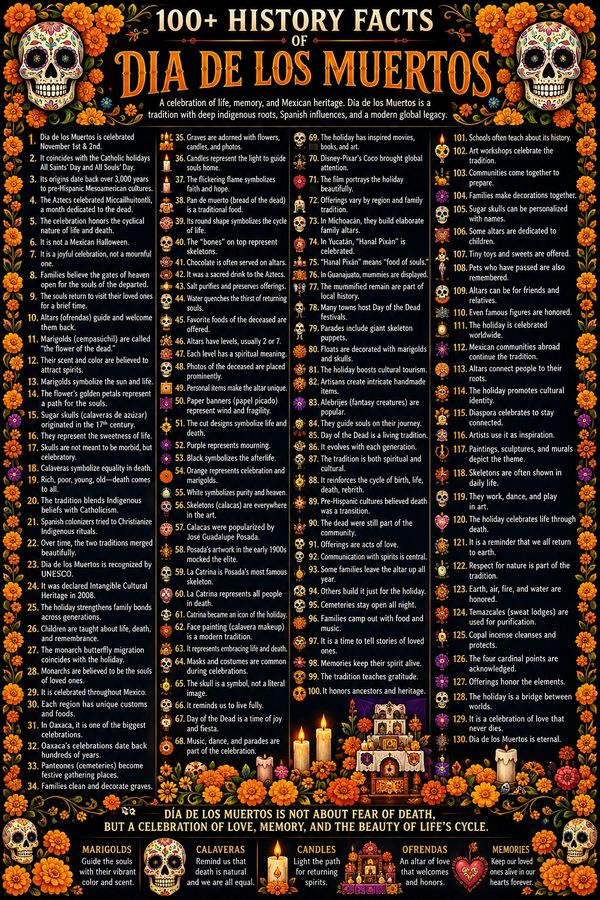
100+ Historic Day of the Dead Facts
Spanish influence on Day of the Dead

Experience The Spanish Colonial Influence on Día de los Muertos
The Spanish Colonial Influence on Día de los Muertos is the story of how Indigenous Mexican traditions and Catholic beliefs came together over centuries to form the modern celebration of Día de los Muertos. Understanding this history helps explain why the holiday contains both ancient Mesoamerican symbols and Christian elements.
🏺 Before the Spanish Arrived
Before the arrival of the Spanish in the early 1500s, many Indigenous peoples in what is now Mexico—including the Mexica (Aztec), Maya, Purépecha, Zapotec, and Mixtec—held ceremonies to honor their ancestors. Death was viewed as a natural part of life's cycle rather than something to be feared.
Common traditions included:
- 🌽 Offering food to ancestors
- 🌺 Decorating ceremonial spaces with flowers
- 🔥 Using incense and fire in rituals
- 💧 Offering water for the journey of the dead
- 🎶 Music, dance, and storytelling to remember loved ones
⛪ The Spanish Arrival
In 1519, the Spanish expedition led by Hernán Cortés arrived in Mexico. After the fall of the Mexica capital of Tenochtitlan in 1521, Spain established colonial rule. Catholic missionaries introduced Christianity and encouraged Indigenous communities to adopt Catholic religious practices.
They brought observances such as:
- ✝️ All Saints' Day (November 1)
- 🕯️ All Souls' Day (November 2)
These days focused on honoring saints and praying for the faithful departed.
🤝 A Cultural Blending
Rather than completely replacing Indigenous customs, many traditions blended together over generations. Historians often describe this as religious or cultural syncretism.
Examples include:
Indigenous TraditionCatholic InfluenceModern Día de los Muertos🌺 Flowers for ancestorsChurch altar decorationsMarigolds decorating ofrendas🍞 Food offeringsBread used in religious traditionsPan de Muerto and favorite foods🔥 Ritual fire🕯️ Candles for prayerCandles guiding returning souls🏺 Honoring ancestors🙏 Prayers for the deadFamily altars with photos and offerings💧 Water offeringsHoly water symbolismWater placed on ofrendas
🕯️ The Ofrenda
Today's ofrenda (altar) reflects this blending of traditions.
You may find:
- 📸 Photographs of loved ones
- 🌺 Marigolds (cempasúchil)
- 🕯️ Candles
- 💧 Water
- 🧂 Salt
- 🍞 Pan de Muerto
- 🍎 Favorite foods and drinks
- ✝️ A cross or religious image (in many families)
Not every ofrenda includes every item. Customs vary by family, region, and personal beliefs.
🌎 Why It Matters
Día de los Muertos is not simply an Indigenous ceremony or a Catholic holiday. It is a tradition that developed through centuries of interaction between Indigenous peoples and Spanish colonial society. Today, it continues to evolve while remaining centered on remembering loved ones, celebrating their lives, and strengthening family connections.
💀 Key Takeaways
- 🏺 Indigenous traditions honoring ancestors existed long before Spanish colonization.
- ⛪ Catholic observances of All Saints' Day and All Souls' Day influenced the timing and some practices.
- 🌺 Many symbols—such as marigolds, food offerings, and ancestor remembrance—have Indigenous origins.
- 🕯️ Candles, prayers, and some altar elements reflect Catholic influence.
- ❤️ Modern Día de los Muertos is the result of centuries of cultural blending, with regional and family traditions continuing to shape how it is celebrated today.
This historical blending is one of the reasons Día de los Muertos is recognized as a rich expression of Mexican cultural heritage, combining ancient traditions with later religious influences while remaining focused on honoring and remembering loved ones. Remember