Signed in as:
filler@godaddy.com

Aztec Traditions and the Origins of Día de los Muertos
Día de los Muertos has deep roots in the beliefs and traditions of the ancient Aztec civilization. Long before the arrival of the Spanish, the Aztecs honored their ancestors through Indigenous ceremonies that celebrated the continuous cycle of life, death, and rebirth. Rather than viewing death as an end, they believed it marked the beginning of another journey.
The Aztecs held festivals dedicated to the dead, offering food, flowers, incense, and personal belongings to help guide the spirits of loved ones. These ceremonies often took place during the summer months and were later merged with the Catholic observances of All Saints' Day and All Souls' Day after the Spanish conquest. Over time, these Aztec traditions evolved into the modern celebration of Día de los Muertos, observed on November 1 and 2.
Central to Aztec beliefs was the idea that the souls of the deceased could return to visit their families. Families welcomed them with ofrendas, decorative altars filled with candles, marigolds, food, water, photographs, and meaningful objects.
Key Aztec Traditions That Influenced Día de los Muertos
1. Honoring ancestors through ceremonies and offerings.
2. Believing that death is a natural part of life's continuous cycle.
3. Creating sacred spaces with food, flowers, incense, and symbolic objects.
4. Using marigold flowers to help guide spirits home.
5. Burning copal incense for purification and as an offering to the gods and ancestors.
6. Celebrating the return of loved ones rather than mourning with sadness.
7. Sharing food, stories, music, and community gatherings to remember those who have passed.
Aztec Beliefs About the Afterlife
The Aztecs believed that a person's destination after death depended on how they died, rather than whether they had lived a good or bad life. Some souls traveled to Mictlan, the underworld ruled by the god Mictlantecuhtli and the goddess Mictecacihuatl, often known as the 'Lady of the Dead.' According to tradition, the journey to Mictlan lasted several years before the soul reached its final resting place.
Lasting Legacy
Today, Día de los Muertos continues to honor these ancient Aztec traditions while blending Indigenous Mexican customs with Catholic influences. Families gather to remember their loved ones with colorful altars, marigold flowers, candles, music, favorite foods, sugar skulls, and heartfelt stories. The holiday remains a joyful celebration of remembrance, family, culture, and the enduring connection between the living and those who came before them.
Continue exploring Día de los Muertos traditions, including family ofrendas, cemetery visits, marigolds, candles, food, music, and remembrance.

Indigenous Ceremonies Related to Día de los Muertos
Día de los Muertos is deeply rooted in the traditions of many Indigenous peoples of Mexico, including the Aztec traditions. Long before the Spanish arrived, Indigenous communities engaged in ceremonies to honor their ancestors, holding the belief that death represents a continuation of life and that the spirits of loved ones remain connected to the living.
These Indigenous ceremonies celebrated remembrance, gratitude, and the enduring relationship between families and their ancestors. Offerings of food, flowers, water, incense, and personal belongings were placed in sacred spaces, known as ofrendas, to welcome returning spirits and provide comfort on their journey.
Following the Spanish conquest in the 16th century, many Indigenous traditions blended with Catholic observances of All Saints' Day and All Souls' Day. This cultural fusion gave birth to the modern Día de los Muertos celebration, while preserving numerous Indigenous customs that are celebrated today.
Common Indigenous Ceremonies and Traditions
- Honoring ancestors with ceremonial offerings.
- Constructing altars, or ofrendas, adorned with meaningful objects.
- Burning copal incense to purify spaces and guide spirits.
- Decorating with marigold flowers (cempasúchil), believed to help lead spirits home with their bright color and fragrance.
- Offering traditional foods, water, and drinks to nourish visiting souls.
- Lighting candles to symbolize hope, remembrance, and guidance.
- Engaging in singing, dancing, praying, and sharing stories about loved ones.
- Visiting burial sites to clean graves, decorate them with flowers, and spend time in remembrance.
- Creating handmade decorations, including paper art and symbolic crafts.
- Gathering as families and communities to celebrate the lives of those who have passed, emphasizing cherished memories rather than solely focusing on loss.
Indigenous Peoples Who Shaped the Tradition
Numerous Indigenous cultures have influenced the customs that thrive today, including the:
- Aztec (Mexica)
- Maya
- Purépecha
- Zapotec
- Mixtec
- Totonac
- Otomí
- Nahua
- Huastec
Each community possesses unique traditions, languages, music, foods, and ceremonies, but they collectively hold a profound respect for their ancestors and share the belief that remembrance of the dead keeps their memories alive.
The Living Tradition
Today, Día de los Muertos stands as one of Mexico's most significant cultural celebrations. It reflects centuries of Indigenous knowledge, spirituality, and family traditions that continue to be transmitted through generations. By crafting ofrendas, sharing meals, telling stories, and gathering in remembrance, families celebrate the enduring bond between the living and their ancestors.

Miccailhuitontli and Its Connection to Día de los Muertos
Miccailhuitontli (also spelled Miccailhuitontli or Miccailhuitl) was an ancient Mexica (Aztec) festival rooted in Aztec traditions, dedicated to honoring children who had died. The name derives from the Nahuatl language, where 'micca' means the dead and 'ilhuitl' translates to festival or celebration. This observance can be interpreted as 'Festival of the Little Dead' or 'Feast of the Children.'
In the Mexica calendar, Miccailhuitontli served as a ceremonial occasion that honored the spirits of deceased children. Families prepared ofrendas, created offerings, and engaged in rituals to remember and welcome these young souls. This festival highlighted the belief that death is part of a broader cycle of existence, maintaining a connection between the living and the spirits of loved ones.
Traditions Associated With Miccailhuitontli
The traditions associated with Miccailhuitontli included:
- Honoring children who had passed away through offerings and remembrance.
- Preparing special foods and gifts for returning spirits.
- Decorating sacred spaces with flowers, incense, and meaningful objects.
- Holding ceremonies that featured prayers, songs, and community gatherings.
- Recognizing the importance of children within the family structure and the spiritual world.
Connection to Modern Día de los Muertos
Miccailhuitontli is often regarded as a pivotal Indigenous ceremony that has influenced modern Día de los Muertos, particularly the observance of November 1, known today as Día de los Angelitos ('Day of the Little Angels'), which honors children who have died.
When Spanish missionaries arrived in Mexico in the 1500s, the Indigenous ceremonies celebrating the dead merged with Catholic festivities like All Saints’ Day and All Souls’ Day. Over the years, these traditions evolved into the Día de los Muertos celebration recognized today within Mexican culture.
Although modern Día de los Muertos differs from the ancient Mexica festivals, it embodies many common themes: honoring ancestors, remembering loved ones, celebrating life, and nurturing a spiritual connection between the living and the deceased.
Quick Facts
Culture: Mexica (Aztec)
Language: Nahuatl
Meaning: Festival of the Little Dead
Purpose: To honor deceased children
Modern Connection: Influenced traditions associated with Día de los Angelitos on November 1
Symbols Shared With Día de los Muertos: Offerings, flowers, food, incense, and remembrance of loved ones
This content is ready to copy and paste for a Día de los Muertos history page.

Honoring Ancestors and Día de los Muertos
Honoring ancestors is one of the most important traditions of Día de los Muertos, a celebration deeply rooted in Mexican culture. This occasion is based on the belief that death does not sever the connection between families. Instead, loved ones who have passed away continue to live through memories, stories, and the traditions that bind generations.
During Día de los Muertos, families embrace the spirits of their ancestors by creating ofrendas (altars) filled with items that symbolize love, respect, and remembrance. These altars, reminiscent of Indigenous ceremonies, provide a space for families to pay tribute to those who came before them and celebrate the lives they have shared.
Ways Ancestors Are Honored During Día de los Muertos
- Creating an ofrenda: Families build altars adorned with photographs, candles, flowers, food, and personal items that belong to deceased loved ones.
- Displaying photographs: Pictures help welcome the spirits and keep the memory of ancestors alive.
- Offering favorite foods and drinks: Traditional dishes and cherished meals are placed on the altar as expressions of love and hospitality.
- Lighting candles: Candles symbolize hope, remembrance, and serve as a guiding light for spirits returning home.
- Using marigold flowers (cempasúchil): The vibrant colors and powerful scent of these flowers are believed to help guide ancestors back to the family gathering.
- Sharing stories: Families recount tales about their loved ones, passing down memories and family history in a beautiful ritual aligned with Aztec traditions.
- Visiting cemeteries: Relatives clean and decorate graves, bringing flowers, music, prayers, and offerings to honor those who have passed.
- Preparing traditional foods: Cooking family recipes preserves cultural heritage and strengthens connections across generations.
Indigenous Roots of Ancestor Honoring
Many Indigenous cultures of Mexico, including the Mexica (Aztec), Maya, Zapotec, Mixtec, and Purépecha peoples, practiced ceremonies honoring ancestors long before Día de los Muertos became the widely celebrated occasion known today. These age-old traditions recognized ancestors as an essential link between the past, present, and future.
The Meaning Today
Día de los Muertos is not merely a celebration of death; it is a vibrant celebration of life, memory, family, and heritage. By honoring ancestors, families acknowledge the sacrifices, teachings, and traditions that are passed down through generations. This holiday serves as a poignant reminder that while loved ones may no longer be physically present, their stories and spirit remain a vital part of the family.
Key Message: "To remember our ancestors is to keep their legacy alive."

### Spanish Influence and Día de los Muertos
The arrival of the Spanish in Mexico during the 16th century significantly impacted the evolution of Día de los Muertos. Prior to European contact, Indigenous peoples—including those from Aztec traditions—held ceremonies that honored ancestors and recognized the deep connection between life and death. Following the Spanish conquest, these Indigenous ceremonies began to merge with Catholic beliefs and religious festivities, resulting in many of the customs associated with Día de los Muertos today.
Spanish missionaries introduced Catholic observances such as All Saints’ Day (November 1) and All Souls’ Day (November 2), both dedicated to honoring saints and deceased members of the Christian community. These celebrations became intertwined with Indigenous practices of creating ofrendas, paying tribute to ancestors, and inviting the spirits of loved ones to join the festivities.
### Spanish Influences on Día de los Muertos
- **Catholic Calendar Dates:** The celebration adapted to align with November 1 and November 2, the Catholic days focused on honoring the dead.
- **Prayers and Religious Symbols:** Traditional Catholic prayers, along with crosses, images of saints, and religious artwork, became integral components of many ofrendas.
- **Church Traditions:** Practices such as visiting cemeteries, holding communal prayers, and honoring the deceased intertwined with Catholic customs.
- **Candles:** The use of candles symbolizes both Indigenous spiritual practices and Catholic traditions, representing faith, guidance, and remembrance.
- **European Flowers and Decorations:** Spanish and European influences introduced new artistic styles and decorative elements that harmonized with Indigenous designs.
- **Food Traditions:** The incorporation of Spanish ingredients and cooking methods also influenced many traditional foods prepared for Día de los Muertos celebrations.
### A Cultural Blend
Día de los Muertos exemplifies a rich fusion of Indigenous Mexican traditions and Spanish Catholic influences. While Spanish colonization altered certain aspects and timing of the celebration, the core Indigenous beliefs about honoring ancestors, presenting offerings, and maintaining a connection with the deceased have persisted.
Today, Día de los Muertos reflects centuries of cultural exchange, celebrating a unique blend of Indigenous heritage, Spanish influence, family traditions, and communal memories to honor those who have passed away.
### Key Message:
"Día de los Muertos is a celebration shaped by Indigenous roots, including Aztec traditions, and Spanish influences, creating a vibrant tradition that honors life, memory, and ancestors."

Modern Día de los Muertos is a celebration that honors ancient Aztec traditions and Indigenous ceremonies while embracing new forms of art, culture, and community expression. Today, this holiday is celebrated throughout Mexico, the United States, and around the world as a way to remember loved ones, preserve family history, and celebrate the connection between generations.
Families continue traditional practices such as creating ofrendas, decorating gravesites, lighting candles, placing marigold flowers (cempasúchil), preparing favorite foods, and sharing stories about those who have passed away. These customs transform remembrance into a vibrant celebration of life, love, and Mexican culture.
Modern Día de los Muertos Traditions
Community Celebrations: Cities and neighborhoods host festivals featuring music, dance, art exhibits, and cultural performances that highlight the rich heritage of Indigenous customs.
Catrina Art and Face Painting: The image of La Catrina, the elegant skeleton figure, has become one of the most recognizable symbols of Día de los Muertos, embodying both tradition and modern artistry.
Contemporary Artwork: Artists reinterpret traditional symbols such as skulls, flowers, and ancestors through paintings, murals, digital art, sculptures, and photography, bridging the old and the new aspects of this celebration.
Public Ofrendas: Museums, schools, businesses, and communities create large altars to honor important cultural figures and local members, illustrating the importance of these heartfelt tributes.
Cultural Education: Many celebrations educate younger generations about Mexican history, Indigenous traditions, and the significance of remembering ancestors, ensuring the legacy of Día de los Muertos lives on.
Día de los Muertos in the Modern World
Modern celebrations have expanded beyond Mexico, while still maintaining their profound cultural meaning. Mexican American communities have played a vital role in preserving and evolving this tradition through art, activism, and public celebrations, fostering greater awareness of the holiday’s history and significance.
Today, Día de los Muertos represents a bridge between the past and present. It honors Indigenous roots, family traditions, and modern creativity while reminding individuals that the memory of loved ones continues through stories, art, and generations to come.
Key Message:
"Día de los Muertos is a living tradition where Aztec traditions, history, art, and family come together to celebrate the lives of those who came before us."
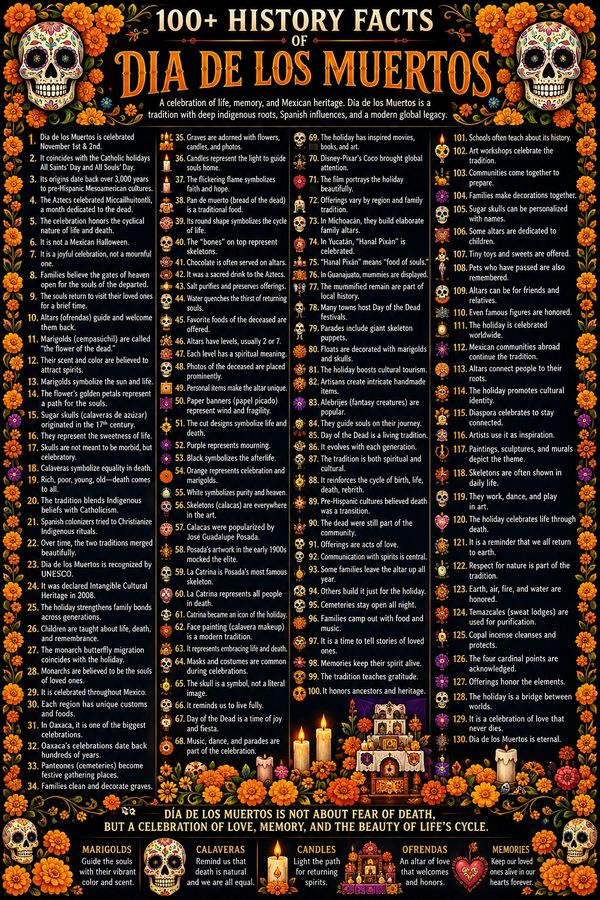
Discover everything you need to know about Día de los Muertos, including 100+ interesting facts and useful information about the history of this vibrant celebration that honors Aztec traditions and Indigenous ceremonies in Mexican culture. Learn how ofrendas play a crucial role in this meaningful holiday.

The Spanish Colonial Influence on Día de los Muertos illustrates the convergence of Indigenous Mexican traditions and Catholic beliefs over centuries, shaping the modern celebration of Día de los Muertos. Understanding this historical narrative reveals the coexistence of ancient Mesoamerican symbols and Christian elements within the holiday.
🏺 Before the Spanish Arrived
Prior to the arrival of the Spanish in the early 1500s, many Indigenous peoples in what is now Mexico—including the Mexica (Aztec), Maya, Purépecha, Zapotec, and Mixtec—practiced Indigenous ceremonies to honor their ancestors. In these cultures, death was regarded as a natural part of life's cycle, not something to be feared.
Common traditions included:
🌽 Offering food to ancestors
🌺 Decorating ceremonial spaces with flowers
🔥 Using incense and fire in rituals
💧 Offering water for the journey of the dead
🎶 Music, dance, and storytelling to remember loved ones
⛪ The Spanish Arrival
In 1519, the Spanish expedition led by Hernán Cortés arrived in Mexico. Following the fall of the Aztec capital of Tenochtitlan in 1521, Spain established colonial rule. Catholic missionaries introduced Christianity, urging Indigenous communities to adopt Catholic religious practices, including observances such as:
✝️ All Saints' Day (November 1)
🕯️ All Souls' Day (November 2)
These days emphasized honoring saints and praying for the faithful departed.
🤝 A Cultural Blending
Instead of entirely replacing Indigenous customs, many traditions blended over generations, a phenomenon often described by historians as religious or cultural syncretism.
Examples include:
Indigenous Tradition | Catholic Influence | Modern Día de los Muertos
---|---|---
🌺 Flowers for ancestors | Church altar decorations | Marigolds decorating ofrendas
🍞 Food offerings | Bread used in religious traditions | Pan de Muerto and favorite foods
🔥 Ritual fire | 🕯️ Candles for prayer | Candles guiding returning souls
🏺 Honoring ancestors | 🙏 Prayers for the dead | Family altars with photos and offerings
💧 Water offerings | Holy water symbolism | Water placed on ofrendas
🕯️ The Ofrenda
The contemporary ofrenda (altar) embodies this melding of traditions. You may find:
📸 Photographs of loved ones
🌺 Marigolds (cempasúchil)
🕯️ Candles
💧 Water
🧂 Salt
🍞 Pan de Muerto
🍎 Favorite foods and drinks
✝️ A cross or religious image (in many families)
Not every ofrenda includes all these items; customs can vary widely by family, region, and personal beliefs.
🌎 Why It Matters
Día de los Muertos transcends being merely an Indigenous ceremony or a Catholic holiday; it represents a tradition that evolved through centuries of interaction between Indigenous peoples and Spanish colonial society. Today, it continues to evolve, remaining centered on honoring loved ones, celebrating their lives, and strengthening family connections.
💀 Key Takeaways
🏺 Indigenous traditions honoring ancestors existed long before the Spanish colonization.
⛪ Catholic observances of All Saints' Day and All Souls' Day influenced the timing and some practices.
🌺 Many symbols—such as marigolds, food offerings, and ancestor remembrance—are rooted in Aztec traditions.
🕯️ Candles, prayers, and other altar elements reflect Catholic influence.
❤️ Modern Día de los Muertos is the result of centuries of cultural blending, with unique regional and family traditions continuously shaping its celebration today.
This intertwining of history and culture is one of the reasons Día de los Muertos is celebrated as a profound expression of Mexican culture, bringing together ancient traditions with later religious influences, while steadfastly focusing on honoring and remembering loved ones.


Discover more about Aztec traditions and the significance of Día de los Muertos on the Friends of the Dead page, or click the link below to explore Indigenous ceremonies and the importance of ofrendas in Mexican culture.


El Camino Real, which translates to 'The Royal Road' or 'The King’s Highway,' served as the historic network of routes linking California’s 21 Spanish missions, as well as presidios and pueblos. Founded between 1769 and 1823, these missions extended from San Diego to Sonoma. During this period, various groups, including priests and soldiers, transported supplies and messages along these routes, contributing to Spain's colonial expansion in Alta California. Today, El Camino Real stands as a significant part of California's history. Within this context, the mission system is also examined for its lasting impact on California’s Indigenous peoples, encompassing displacement, disease, forced labor, and cultural disruption. Additionally, many of the Indigenous ceremonies that have survived, such as those honoring Aztec traditions and Día de los Muertos, reflect how Mexican culture continues to thrive, with ofrendas playing a crucial role in these celebrations.

Those distinctive mission bells seen along California’s Highway 101 are El Camino Real markers, celebrating the historic route linked to California’s Spanish missions. While these bells are not original mission-era artifacts, they serve as an important reminder of the cultural heritage that includes elements of Mexican culture and Indigenous ceremonies. The roadside marker program, which began in 1906, highlights the influence of Aztec traditions and the significance of ofrendas in commemorating life and death, especially during events like Día de los Muertos.
Quick Facts
The first commemorative bell marker was installed in Los Angeles in 1906. The traditional marker features a bell suspended from a shepherd’s-crook-style post. By 1913, about 450 bell markers had been installed, though many disappeared over the decades due to highway construction, theft, damage, and relocation. Caltrans later installed hundreds of replacement markers along portions of US 101. The familiar dates on these markers represent two key events: 1769, the founding year of Mission San Diego de Alcalá, and 1906, marking the start of the bell-marker era. Highway 101 follows or parallels parts of the commemorative El Camino Real route, although the historic mission road was more complex than today’s US 101.

California mission architecture developed from Spanish Colonial traditions, integrating local materials and Indigenous labor alongside building knowledge from cultures such as the Aztec traditions. Many missions embraced thick sun-dried adobe walls, stone foundations, wooden beams, clay-tile roofs, covered walkways, courtyards, and bell towers or bell walls, reflecting a blend of architectural influences. National Park Service
Typical mission complexes included:
⛪ Church — Center of religious life
🔔 Bell Tower or Bell Wall — Called people to services and daily activities
🧱 Adobe Walls — Provided thick, durable construction using local earth
🏺 Clay Tile Roofs — Helped protect adobe structures from rain
🌿 Courtyard — A central working and gathering space often used for Indigenous ceremonies and community activities
🛠️ Workshops — Blacksmithing, weaving, carpentry, and other trades that contributed to Mexican culture
🌾 Farms & Gardens — Produced food and agricultural goods, pivotal for sustenance
💧 Water Systems — Aqueducts, fountains, wells, and irrigation systems essential for mission life
🪦 Cemetery — Burial grounds associated with many missions, where ofrendas might be found during Día de los Muertos
🏠 Living Quarters — Housing for missionaries and, in various forms, Indigenous residents and workers
While we recognize a distinct “California Mission” look today, the 21 missions were not architecturally identical. Their designs evolved based on location, available materials, seismic activity, and subsequent restoration efforts. California State Parks

Mission bells historically served both practical and religious purposes in Spanish mission communities, where they played a vital role in regulating the day—calling people to worship and prayer and signaling activities such as work and meals. According to the National Park Service, these bells were integral to mission life.
During Día de los Muertos, bells take on a different yet related significance in some Mexican cultures. In accordance with Indigenous ceremonies, church bells may be rung to announce and spiritually guide the returning ánimas—the souls of deceased loved ones—toward their families and ofrendas. This practice varies across regions and communities; therefore, bells are not universally required during Día de los Muertos. As noted by Mexico’s National Institute of Indigenous Peoples, this tradition reflects the rich tapestry of Mexican culture.
What Mission Bells Represent:
🔔 Calling — Summoning the community
🙏 Prayer — Calling people to religious services
⏰ Time — Organizing daily mission activities
⛪ Catholic Faith — A pivotal aspect of mission religious life
🕯️ Remembrance — Bells often accompany prayers for the deceased
💀 Día de los Muertos — In various Mexican traditions, the ringing of bells serves to announce or guide returning souls
🌼 Spiritual Journey — Similar to the use of marigolds, the sound of bells can provide guidance in certain local traditions
🕊️ Passing & Mourning — The tolling of bells has long been associated with death and memorial observances.
Long before the Spanish missions were established, California was home to diverse Indigenous nations, each rich in their own languages, religions, and cultural traditions, including the strong influence of Aztec traditions. The mission system, established beginning in 1769, dramatically changed their lives.
Indigenous peoples provided much of the labor that built and sustained the missions, including farming, construction, livestock care, cooking, weaving, and other skilled work. However, mission life also brought profound suffering. Native communities faced forced labor, introduced diseases, displacement from ancestral lands, religious conversion, cultural suppression, and major population loss. This is where I reflect on the event which took place near the San Fernando Mission, which I call 'Souls in Purgatory.'
Today, descendants of California’s Indigenous peoples continue to preserve and revitalize their languages, ceremonies, and traditional knowledge, reflecting their deep roots in Mexican culture. Celebrations like Día de los Muertos and the creation of ofrendas highlight the importance of these Indigenous ceremonies in keeping their rich heritage alive. Their voices are essential to understanding the complete history of California’s 21 missions.
Agriculture was essential to California mission life, intertwining with various aspects of Indigenous culture, including traditions reminiscent of Aztec ceremonies. Missions developed orchards, vineyards, grain fields, vegetable gardens, and irrigation systems. Crops varied by mission and location, so these are representative examples rather than a list of what every mission grew.
🫒 Olives — Pressed to produce olive oil.
🍇 Mission grapes — Used for wine, including sacramental wine, which plays a role in Mexican culture and celebrations like Día de los Muertos.
🍐 Fruit trees — Pears and other fruits were grown in mission orchards, reflecting the importance of diverse agriculture.
🌾 Wheat — Ground into flour and used as an important grain in various dishes.
🌽 Corn/Maize — An important food crop, historically significant in Indigenous ceremonies.
🌿 Kitchen gardens — Supplied vegetables, herbs, and other foods, supporting both mission life and local traditions.
💧 Irrigation — Water systems helped supply fields, orchards, and gardens, a practice that complements Indigenous land-use traditions.
Historical records for Mission Santa Inés document its orchard and garden, vineyards, olive and pear trees, and a water-powered mill used to grind wheat and corn. National Park Service historic documentation highlights how mission agriculture depended heavily on Indigenous labor, existing alongside—and disrupting—Native Californian food systems, values, and customs, including the creation of ofrendas during Día de los Muertos.
A mission cemetery, often referred to as a campo santo—which translates to “holy field” in Spanish—was traditionally situated near the mission church. These sacred burial grounds, rich in Mexican culture, house the remains of many Indigenous people, including baptized Native Californians, as well as missionaries, soldiers, settlers, and their families. California’s mission cemeteries play a crucial role in preserving Indigenous ceremonies, as they contain a wealth of history linked to the diverse communities that once thrived there, including the traditions akin to Aztec practices observed during Día de los Muertos. California Office of Historic Preservation
Mission Cemetery Facts
🪦 Campo Santo — Spanish for “holy field.”
⛪ Location — Cemeteries were commonly placed beside or near the mission church.
👣 Indigenous history — Large numbers of baptized Native Californians were buried in mission cemeteries.
✝️ Grave markers — Individual headstones were not always used during the mission era.
📖 Burial registers — Franciscan missionaries maintained records documenting many deaths and burials.
🕯️ Sacred ground — These sites should be understood as burial places, not simply architectural features.
🌿 Today — Surviving mission cemeteries and memorials preserve the names and stories of people connected with the missions.
A powerful example is Mission San Juan Capistrano, which boasts records identifying more than 3,400 individuals buried in its campo santo. Among them are Native American men, women, and children, as well as Spanish soldiers and their families. Burials at this historic site began around 1781 and continued into the 1800s. The ofrendas found in these cemeteries serve as a reminder of the deep cultural significance of these burial sites, connecting the past to present-day observances.

Many California missions were named for Catholic saints or sacred figures, reflecting the rich tapestry of Mexican culture. Examples include:
⛪ San Francisco de Asís — St. Francis of Assisi
🌿 Santa Clara de Asís — St. Clare of Assisi
✝️ San Buenaventura — St. Bonaventure
🔔 San Juan Capistrano — St. John of Capistrano
👑 San Luis Rey de Francia — St. Louis IX of France
🕊️ San José — St. Joseph
⚔️ San Miguel Arcángel — St. Michael the Archangel
📯 San Gabriel Arcángel — St. Gabriel the Archangel
🪽 San Rafael Arcángel — St. Raphael the Archangel
Other missions were named for Catholic sacred concepts rather than individual saints, such as Santa Cruz (Holy Cross) and La Purísima Concepción (Immaculate Conception), showcasing how Spanish colonization impacted Indigenous ceremonies.
Connection to Día de los Muertos
The Catholic calendar plays a significant role in understanding modern Día de los Muertos and its ties to both Indigenous traditions and Mexican culture:
November 1 — All Saints Day
Catholics honor all saints and holy people. USCCB
November 2 — All Souls Day
Catholics commemorate and pray for the faithful departed. USCCB
Mexican Día de los Muertos traditions developed through a complex history involving Indigenous traditions, Spanish colonialism, and Catholic observances, including Todos Santos and Fieles Difuntos. Mexico's INAH
That is why you may see crosses, prayers, candles, rosaries, and Catholic sacred images alongside marigolds, photographs, food, and other elements of ofrendas within some families and communities.
It is important for DayoftheDeadArt.com to note that California missions did not create Día de los Muertos. The connection is rooted in Catholic traditions introduced during Spanish colonization, which blended with diverse Indigenous traditions over centuries.

Explore 20 of the most frequently asked questions about the California Missions, including insights into mission history, Native peoples, architecture, daily life, and religion. Delve into the significance of El Camino Real and California heritage, while also learning about the rich Mexican culture surrounding celebrations like Día de los Muertos, which often includes ofrendas, and the enduring Aztec traditions and Indigenous ceremonies that continue to influence these communities.

From 1769 to 1833, California’s 21 missions introduced Catholic traditions like All Saints’ Day and All Souls’ Day to Indigenous California cultures, enriching the diverse tapestry of Mexican culture. While these histories contribute to a larger story of remembrance, including Indigenous ceremonies and the creation of ofrendas, it is important to note that California missions did not create Día de los Muertos, which is rooted in ancient Aztec traditions.

Mexican California (1821–1846) was influenced by Mexican rule, Catholic traditions, and Indigenous communities, which included the rich legacy of Aztec traditions. The region showcased a blend of missions, ranchos, and Californio culture. While Día de los Muertos was not originally established in California, its history reflects the significant merging of Indigenous ceremonies with Catholic All Saints’ and All Souls’ observances in Mexico, often celebrated with vibrant ofrendas.